
UAE Cabinet Charts Ambitious Five-Year Space Strategy, Approves 120 Global Pacts & New Health Initiatives
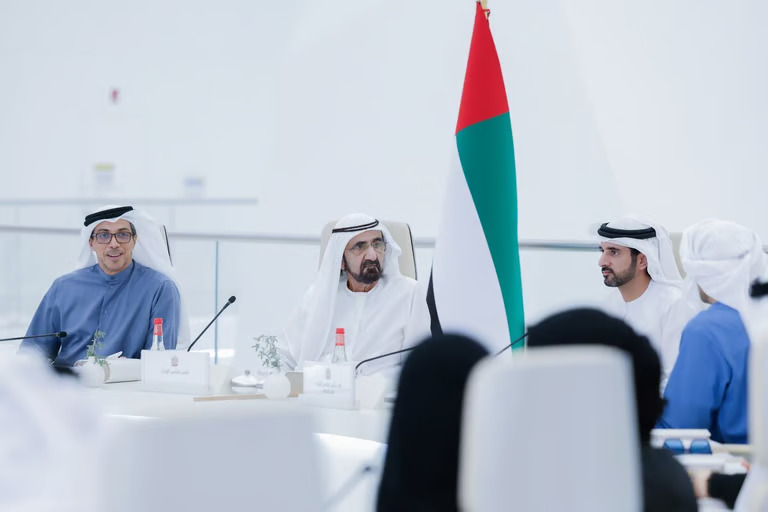
His Highness Sheikh Mohammed bin Rashid Al Maktoum, Vice President, Prime Minister of the UAE, and Ruler of Dubai, presided over a pivotal Cabinet meeting attended by senior leadership, including His Highness Sheikh Mansour bin Zayed Al Nahyan, Sheikh Hamdan bin Mohammed bin Rashid Al Maktoum, Sheikh Maktoum bin Mohammed bin Rashid Al Maktoum, Lt. General Sheikh Saif bin Zayed Al Nahyan, and Sheikh Abdullah bin Zayed Al Nahyan.
The Cabinet opened by commending the UAE Armed Forces, the unified national spirit of citizens and residents, and the exceptional responsibility demonstrated by all operational teams across the country. It affirmed that every sector remains aligned with the President’s vision to protect national assets, sustain high readiness, and ensure the UAE emerges stronger from current developments while rapidly restoring normalcy across all domains.
Praising the nation’s social, media, cultural, and economic pillars during this critical period, the Cabinet stressed the need to intensify efforts and consolidate energies to advance toward a more robust and prosperous future. It reiterated that global confidence in the UAE’s development model is deeply entrenched—built on decades of achievements, consistent commitment, and enduring partnerships with nations, international organizations, and global financial institutions.
A National Space Strategy for the Next Five Years
Sheikh Mohammed announced the approval of the UAE Space Strategy 2031, a roadmap to position the UAE among the world’s top 10 space economies within five years. The sector is currently valued at over AED 44 billion, involving more than 170 national, scientific, and economic entities. The UAE has already developed and launched 30 satellites, established an Emirati astronauts program, executed a scientific mission to Mars, and is preparing a new mission to Venus and the asteroid belt.
The strategy focuses on three core objectives: enhancing investment attractiveness, achieving global leadership in partnerships and market access, and developing competitive space infrastructure. Key targets include doubling space economy revenues, ranking among the top 10 global space economies by 2031, increasing economic value added, doubling the number of national space companies, expanding export markets, doubling infrastructure investments, and doubling UAE-based space startups.
Integrative Medicine & Healthy Nutrition Strategies
The Cabinet approved the National Integrative Medicine Strategy, aiming to make the UAE a global reference by building a balanced healthcare system that integrates modern, traditional, and complementary medicine—supported by evidence-based practices, research, innovation, talent development, and international collaboration. The strategy rests on seven pillars: governance, service integration, insurance coverage, education and capacity building, research and innovation, growth and collaboration, and community awareness. It includes 16 initiatives, such as establishing a governance framework, updating legislation, adopting national clinical guidelines, expanding insurance coverage, mandating continuing medical education, and forming a professional association for integrative medicine.
Additionally, the National Healthy Nutrition Strategy 2031 was approved to promote healthier lifestyles, strengthen preventive nutrition, and enhance regulatory frameworks using integrated data. Focused on shifting toward healthy food alternatives, raising awareness, and building institutional capacity, the strategy comprises 16 initiatives—including banning partially hydrogenated oils, regulating unhealthy food and beverage marketing, developing a digital nutrition guide, and establishing a national nutrition monitoring system. Goals include ensuring access to healthy and sustainable food systems, improving nutrition across all age groups, reducing diabetes and obesity rates among adults, limiting childhood obesity, and lowering overweight rates among children under five.
Key Council Reconstitutions
The Cabinet reconstituted the Emirates Genome Council, chaired by H.H. Sheikh Khaled bin Mohamed bin Zayed Al Nahyan, Crown Prince of Abu Dhabi and Chairman of the Abu Dhabi Executive Council. Members include Mohammad Al Gergawi, Ahmed bin Ali Al Sayegh, Omar Sultan Al Olama, Saeed Mubarak Al Hajeri, Mansoor Ibrahim Al Mansoori (Secretary General), and other senior health and AI leaders. The Council will oversee national genome policies, legislation, ethical frameworks, precision medicine initiatives, research priorities, data governance, and capability building.
The National Committee for Sustainable Development Goals was also reconstituted, chaired by the Director General of the Federal Competitiveness and Statistics Centre, with representatives from key ministries. The Emirates Food Security Council was reconstituted under the Minister of Climate Change and Environment, while the National Committee for Civil Aviation Security and Facilitation was restructured under the Chairman of the General Civil Aviation Authority, including military, police, and security leadership.
2025 Achievements: Community Empowerment, Labour Market, and Emiratization
The Cabinet reviewed the Community Empowerment Sector’s 2025 achievements: updated legislation, an AED 100 million Public Non-profit Organisations Empowerment Fund, over 800 public benefit organizations with more than 160,000 members, a 45% expansion in program access, and a 34% increase in inflation allowance coverage. Over 3,800 beneficiaries gained employment and transitioned beyond social support; more than 1,000 national projects were incubated; and Emirati families generated over AED 100 million through home-based business programs.
Labour market developments for 2025 showed a comprehensive social protection system with 99% enrolment in the Wage Protection System, 83% coverage under unemployment insurance, 99% compliance with heat stress policies, and 99% registration in workers’ protection insurance. Four savings funds were adopted to invest and grow end-of-service benefits. Between 2021 and 2025, the UAE recorded 45.76% growth in companies, 101.76% in total workforce, 49.92% in skilled workforce, and 101.92% in female participation—ranking first globally in employment growth, specialized talent availability, low labor disputes, and workforce expansion. Emiratization efforts in 2025 placed 1,130 UAE nationals in banking, 670 in insurance, 562 in exchange houses, and 284 in insurance-related professions.
Islamic Finance, Housing Programme, and Sectoral Reviews
The Cabinet reviewed the UAE Strategy for Islamic Finance and Halal Industry 2025, which includes unifying standards for Islamic banking and sukuk, launching “Fractional Sukuk,” regulating Sharia-compliant digital assets, developing national reference frameworks, and building a central digital infrastructure and blockchain platform for Islamic financial instruments. The strategy aims to expand Islamic finance assets and funds, enhance global rankings, increase halal exports and re-exports, and grow cash waqf assets.
The Sheikh Zayed Housing Programme’s Q1 2026 achievements included 759 housing approvals exceeding AED 616 million—comprising 129 grants (AED 102.9 million), 583 loans and financing solutions (AED 460.5 million), and 47 loans for government housing complexes (AED 53.2 million). Since 1999, the programme has issued over 73,000 housing support decisions exceeding AED 50 billion.
The Cabinet also reviewed reports from the Federal Authority for Identity, Citizenship, Customs and Ports Security; the Public Education Sector; and the Climate Change and Environment Sector. It examined the National Framework for Sustainable Fisheries, which has deployed 19,458 artificial reefs, installed 66,173 climate-resilient coral units (by 2025), and planted over 52 million mangrove trees (by 2024), alongside new fish stock management and data collection mechanisms.
120 International Agreements & Legislative Approvals
The Cabinet approved the ratification and signing of 120 international agreements and MoUs, including Comprehensive Economic Partnership Agreements with Nigeria, the Philippines, the Democratic Republic of the Congo, Sierra Leone, and Gabon; investment agreements with Canada, Palau, Dominica, and Trinidad and Tobago; and approvals to host major international conferences in the UAE.
On the legislative front, the Cabinet approved executive regulations and decisions covering endowments, unified customs tariffs, federal entity services, legal metrology, type approval systems for measuring instruments, and regulatory updates across taxation and other sectors.
Finally, the Cabinet reviewed progress on multiple national policies and strategies, including women’s health, health risk prevention, healthy lifestyles, economic clusters, digital accessibility, chemicals management, biosecurity, labour market compliance, and the National Strategy for Cultural and Creative Industries 2031. Reports from various councils and committees—including the Emirates Research and Development Council, Health Council, National Competitiveness Committee, Economic Integration Committee, Sustainable Aviation Fuel Committee, and Government Financial Policy Coordination Council—were also examined, along with the performance of federal boards such as the Emirates Investment Authority, UAE Space Agency, Capital Market Authority, and Sports Coordination Council. The seventh national biodiversity report under the UN Convention on Biological Diversity was approved.